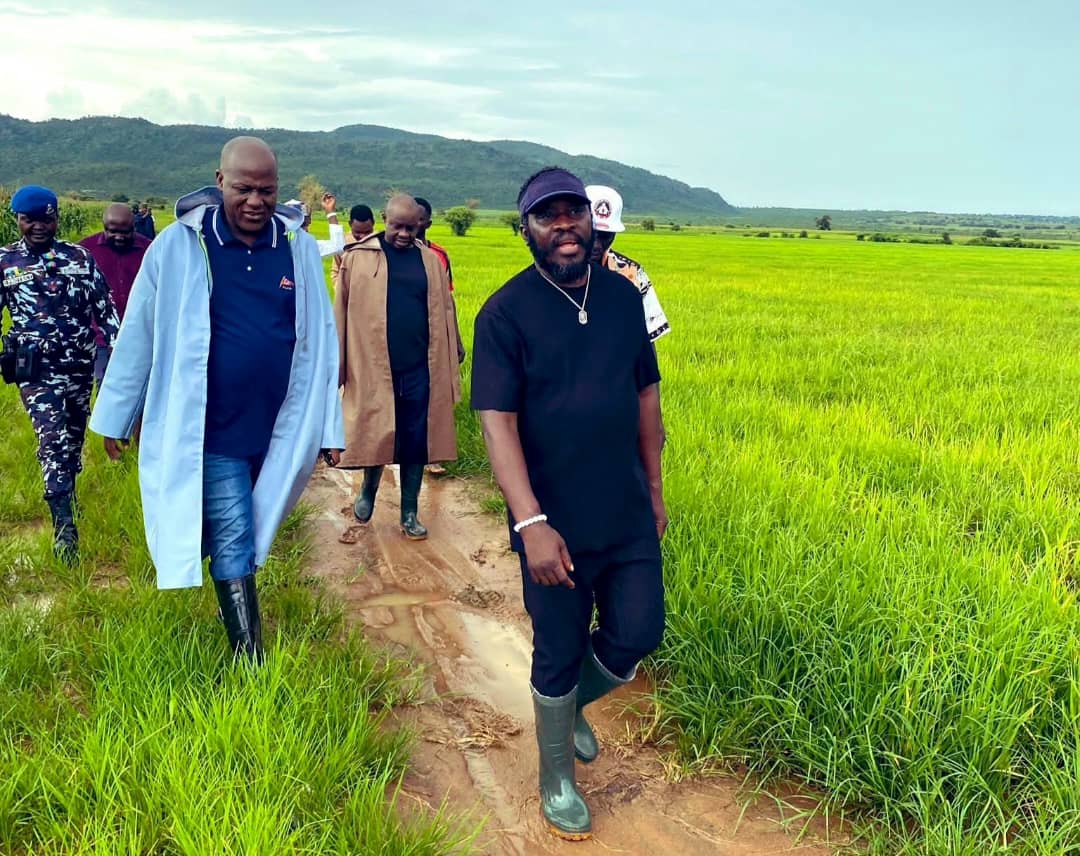
A disagreement has emerged between the management of the Plateau Youth Agricultural Empowerment Programme (P-YAEP) and Chief Kefas Wungak Ropshik, Chief Executive Officer of Kefiano Farms, over the suspension of farming activities on a portion of land at the BARC Farms facility in Bassa Local Government Area of Plateau State.
The controversy began when Chief Ropshik alleged that workers at his farm site were instructed to suspend operations following a directive from the Plateau State Government. In a public statement, he described the action as an act of political vindictiveness and expressed concern about its impact on workers and intended beneficiaries of his agricultural investments.
According to him, the decision would not personally affect him as much as it would affect ordinary citizens who depend on the farm for their livelihoods.
“Personally, I am not the victim of this decision. God has blessed me abundantly. Last season, the proceeds from this farm, alongside those from my farms in Shendam and Wase, were largely directed toward supporting Plateau citizens in need,” he stated.
Ropshik further argued that the suspension could have wider economic consequences for the host community.
“What is regrettable is that this action ultimately affects ordinary people. It denies support to intended beneficiaries and threatens the livelihoods of hundreds of workers from the host community in Bassa who depend on the farm for income and sustenance,” he said.
The businessman also questioned the moral basis of the decision, asking whether it was consistent with Christian values and the responsibilities entrusted to public office holders to deprive citizens of opportunities and means of livelihood.
However, the management of P-YAEP has strongly rejected the allegations, insisting that the suspension was neither political nor selective but rather the enforcement of established operational regulations governing activities within BARC Farms.
In a detailed rebuttal, the management stated that Chief Ropshik did not possess a formal lease agreement with the Plateau State Government. According to the statement, his use of the farmland during the 2025 farming season was based on a one-time arrangement that allowed him to cultivate 100 hectares without paying lease fees or land charges.
The management further alleged that the approved allocation was exceeded.
“While management was focused on organizing youth participants, Chief Ropshik bypassed protocols and doubled his allocation to 200 hectares without permission. Because his crops were already planted, ASTC leniently allowed him to proceed but explicitly warned him that all cleared portions were already allocated for future cycles,” the statement said.
P-YAEP also maintained that the immediate cause of the suspension was the alleged introduction of unauthorized tractors into the farm.
“The established rule dictates that no individual or foreign tractor is allowed to operate within the facility. Only government-approved ASTC tractors are permitted. Chief Kefas violated this rule by bringing in foreign tractors without management clearance. Security rightfully halted this illegal operation,” the management stated.
Rejecting claims of selective treatment, the programme management argued that several other investors and local stakeholders who failed to follow approved procedures were similarly stopped from operating on portions of the farm.
“There is no selective enforcement here. Other affected individuals and investors have since returned to management with their formal applications, respecting the farm’s protocol to request space. Chief Kefas is the sole exception,” the statement added.
The management nevertheless indicated that the door remains open for future participation, noting that Chief Ropshik could formally apply for land allocation through the approved channels if he wishes to continue farming at the facility.
Beyond the controversy, P-YAEP announced significant changes to its operations for the 2026 farming season. The programme disclosed plans to allocate 1,000 hectares into 200 precision units of five hectares each, with 200 youth groups benefiting from the scheme. It also revealed that 200 government-procured hand tillers would be distributed to support cultivation activities.
The management further stated that BARC Farms is expanding beyond the cultivation of maize, rice, and soya beans, with plans to focus on specialized grass production for livestock feed targeted at export markets.